 Whatsapp: +86 13584829534



Search for more information


Solder paste should normally be stored in a sealed container under controlled refrigeration and removed only when production requires it. For many conventional SMT solder pastes, the recommended refrigerated range is 0–10°C (32–50°F), followed by controlled temperature recovery to approximately 19–25°C (66–77°F) before the container is opened.
However, these values are not universal. Alloy composition, flux chemistry, powder size and packaging format can all change the required storage temperature, shelf life and warming procedure. The solder paste manufacturer’s Technical Data Sheet, or TDS, must therefore remain the primary process reference.
Correct solder paste storage is not simply a matter of putting jars in a refrigerator. A reliable process must control:
Storage temperature and temperature uniformity
Lot number, production date and expiration date
Refrigeration-to-room-temperature transitions
Cumulative room-temperature exposure
FIFO or FEFO material dispensing
Mixing or stirring parameters
Opened and returned materials
Temperature excursions and abnormal handling
Operator permissions and traceability records
When these variables are not controlled, solder paste can develop higher viscosity, flux separation, reduced tack, inconsistent stencil release and incomplete solder-powder coalescence.
Solder paste is a mixture of metal powder and a chemically active flux system. Even while the container is sitting in storage, flux activators remain in direct contact with the solder particles.
Over time, these activators can react with oxide layers on the solder powder. Excessive interaction may cause particles to agglomerate or partially bond together. The resulting material can become more viscous and may have difficulty passing through small stencil apertures or dispensing needles.
Refrigeration does not stop these reactions completely, but it slows them sufficiently to preserve the intended rheology, tack and printing characteristics over the specified shelf-life period. Indium Corporation notes that smaller solder-powder particles have more surface area available to react with the flux, which means fine-powder pastes can be more sensitive to aging than otherwise similar coarse-powder formulations. (Indium Corporation)
Water-soluble solder pastes may also have more chemically aggressive activators than many no-clean formulations. Consequently, their refrigerated shelf life may be shorter.
For many standard no-clean and water-soluble SMT solder pastes, a practical refrigerated storage range is:
| Control item | Typical guideline |
|---|---|
| Long-term refrigerated storage | 0–10°C / 32–50°F |
| Preferred temperature before printing | Above 20°C |
| Common room-temperature recovery target | 19–25°C / 66–77°F |
| Extended high-temperature risk | Above approximately 29–30°C |
| Typical no-clean refrigerated shelf life | Around 6 months |
| Typical water-soluble refrigerated shelf life | Approximately 3–6 months |
Kester recommends storing many conventional solder pastes at 0–10°C immediately after receipt. Its general handling guidance lists a typical refrigerated shelf life of six months for no-clean paste and approximately three to six months for water-soluble paste, although the exact period must be verified in the individual product bulletin. (Kester)
Some specialty solder, sintering and dispensing pastes require temperatures below 0°C, while other formulations should not be frozen. A refrigerator operating at 1–10°C is therefore suitable only when that range matches the solder paste supplier’s specification.
An electronics manufacturer may use several materials at the same time:
SAC305 no-clean solder paste
Low-temperature bismuth-based paste
Water-soluble solder paste
Type 4, Type 5 or Type 6 fine-powder paste
Semiconductor packaging paste
Solder paste supplied in jars, cartridges or syringes
Each material should have a controlled recipe containing its approved storage temperature, warming time, maximum room-temperature exposure, mixing method and expiration rules. Materials requiring incompatible temperature conditions should not be managed under the same generic storage recipe.
Cold solder paste should not be opened immediately after removal from refrigeration. The sealed container must first reach the temperature of the production environment.
This is primarily a condensation-control issue. When a cold container is exposed to warm, humid air, its surface temperature may be below the room’s dew point. Opening the container allows moisture to condense directly on or inside the solder paste.
Consider a production room at 24°C and 60% relative humidity. Its calculated dew point is approximately 15.8°C. A solder paste jar removed from a 5°C refrigerator is more than 10°C below that dew point. Opening it immediately creates a high probability of moisture condensation.
The container should remain sealed until its internal temperature has equilibrated with the production environment—not merely until the outside of the jar feels warm.
Moisture introduced during this stage can affect:
Solder paste viscosity
Stencil release
Solder-ball formation
Flux activity
Slumping
Reflow coalescence
Printing consistency
Indium Corporation recommends allowing sealed containers to equilibrate for at least two hours and up to four hours for larger or frozen containers. In a controlled test using 6-ounce cartridges, solder paste required approximately two hours to reach a 22–24°C ambient temperature. Actual time varies with container size, material mass, initial temperature and room conditions.
Kester gives a general warming period of approximately three to four hours at 19–25°C before use.
A controlled temperature-recovery process should follow these steps:
Release paste according to the approved lot, production order and expiration status. FIFO is the basic rule, but FEFO—first expired, first out—is preferable when different lots have different expiration dates.
The system should record:
Material code
Alloy and flux type
Lot number
Container identification
Expiration date
Refrigeration removal time
Required recovery time
Scheduled production line
Responsible operator or work order
Do not break the seal, loosen the cap or remove a cartridge plug while the material is still cold.
Do not place the paste near an oven, reflow machine, heater or direct sunlight. Indium advises against using temperatures above 25°C to accelerate warming, while Kester recommends recovery within the normal 19–25°C production range.
Do not rely only on operator judgment. The required holding time should be automatically calculated from the material recipe and recorded.
After temperature recovery, inspect the material and follow the paste supplier’s approved homogenization instructions.
The answer depends on the solder paste formulation and packaging.
For paste supplied in jars, gentle hand folding with a clean plastic spatula may be recommended to restore uniformity after minor settling. The objective is to homogenize the material without introducing air.
Cartridges and syringes may not require manual mixing. Some solder paste suppliers specifically state that mechanical or planetary mixing is unnecessary for their materials and should not be used as a shortcut for warming cold paste.
An automated stirring function can improve repeatability in factories where stirring is required, but its parameters must be validated for the exact paste. Excessive speed or time may introduce air, alter temperature or change the apparent rheology.
A validated stirring recipe should define:
| Parameter | Process question |
|---|---|
| Rotation speed | What range is approved by the paste supplier or internal validation? |
| Mixing duration | How long is required to restore uniformity? |
| Container weight | Is automatic balance or weight matching required? |
| Direction and motion | Does the process fold, rotate or centrifugally mix the paste? |
| Paste temperature | Has full temperature recovery been completed? |
| Air introduction | Does the method create visible bubbles or entrapped air? |
| Revalidation | Is testing required after changing alloy, flux or powder type? |
The machine’s maximum capability should never be treated as the default process setting.
There is no single room-temperature limit that applies to every solder paste.
The usable exposure period depends on:
Paste formulation
Initial age
Storage history
Whether the container is sealed, opened or on the stencil
Production temperature and humidity
Airflow inside the printer
Time spent on the stencil
Frequency of printer stoppages
Solder-powder size
Solder paste performance generally changes gradually rather than failing at one exact minute. Higher temperatures accelerate the change.
Kester advises against prolonged storage at 19–25°C and requires users to follow the product-specific room-temperature stability limit. Exposure above approximately 29°C can reduce useful life. (Kester)
Indium notes that paste generally has preferred printing behavior above 20°C. Printing at or below 19°C may contribute to clogging, inconsistent deposit volume, peaking, poor stencil release, paste sticking to the squeegee and failure of the paste bead to roll correctly. Extended exposure above 30°C can contribute to flux separation, chemical decomposition, loss of tack and increased viscosity.
For this reason, manufacturers should track cumulative room-temperature exposure rather than simply recording whether a jar is “inside” or “outside” the refrigerator.
Unopened containers may sometimes be returned to refrigeration, provided the product TDS allows it and the complete temperature history is recorded.
Opened containers require more caution. Re-refrigerating an opened jar can allow condensation to form during the next warming cycle. It also becomes difficult to determine how much moisture, air and contamination entered the material during use.
General best practice is:
Do not return worked stencil paste to a container of fresh paste.
Store removed stencil paste in a separate, clearly identified container.
Never mix different lots unless the supplier and internal process specification permit it.
Record each return-to-storage cycle.
Limit the number of permitted warming and return cycles.
Prioritize returned material for the next approved use.
Reject material after the validated cumulative exposure limit is reached.
Kester and Indium both advise against mixing used stencil paste back into fresh paste because it can alter moisture content, contamination level and rheology.
Container orientation also matters.
Kester recommends storing cartridges vertically with the dispensing tip facing downward. When horizontal storage is unavoidable, its guidance suggests rotating the cartridge 180 degrees approximately once per week.
Indium similarly recommends tip-down storage for syringes and cartridges to support consistent dispensing behavior.
Jars should remain tightly sealed and clearly labeled. Storage shelves should prevent containers from being hidden behind newer stock, and access should be controlled to avoid unrecorded removal.
Solder paste management begins when the material arrives at the factory—not when production removes it from the refrigerator.
A receiving procedure should record:
Supplier and purchase order
Material code and description
Alloy, flux and powder type
Lot and manufacturing date
Use-by or expiration date
Package condition
Temperature indicator status, when provided
Delivery date and time
Time placed into controlled refrigeration
Any transport-temperature exception
Melted gel packs alone do not necessarily prove that the paste exceeded its approved temperature. Where temperature exposure is critical, use a calibrated data logger or temperature-indicator label.
As one manufacturer-specific example, Kester reports that its standard insulated packaging kept paste below 25°C for 48 hours during testing at an ambient temperature of 32°C. This result applies to that packaging system and should not be adopted as a universal acceptance limit for other suppliers. (Kester)
Questionable shipments should be quarantined rather than automatically accepted or discarded.
When solder paste has been left outside refrigeration or exposed to excessive heat, collect the following data before making a disposition decision:
Maximum recorded temperature
Total excursion duration
Whether the package was sealed
Paste age at the time of the excursion
Remaining shelf life
Number of previous warming cycles
Paste type and powder size
Supplier-specific acceptance limits
Then inspect the paste for:
Excessive flux separation
Dry or crusted material around the container
Abnormal thickening
Lumps or agglomerated particles
Inconsistent color or texture
Poor rolling on the stencil
Incomplete aperture filling or release
A controlled printing test, viscosity check and reflow coalescence test may be required. Degraded paste often shows higher viscosity or leaves significant uncoalesced particles after reflow rather than forming a clean solder mass. Final acceptance should be based on supplier guidance and validated quality procedures, not appearance alone. (Indium Corporation)
For an SMT line scheduled to start printing at 08:00, a common workflow might be:
| Time | Action |
|---|---|
| 03:45–04:00 | Release the required sealed jars from refrigerated storage |
| 04:00–07:30 | Hold the containers in the validated temperature-recovery area |
| 07:30 | Verify material ID, lot, recovery time and work order |
| 07:35 | Perform validated homogenization when required |
| 07:45 | Deliver the approved paste to the designated printer |
| 08:00 | Begin printing and start the in-use exposure timer |
| During production | Record replenishment, printer stops and stencil exposure |
| End of shift | Separate worked paste, record disposition and update inventory |
The actual schedule must be adjusted for the paste supplier’s TDS, package size and factory environment.
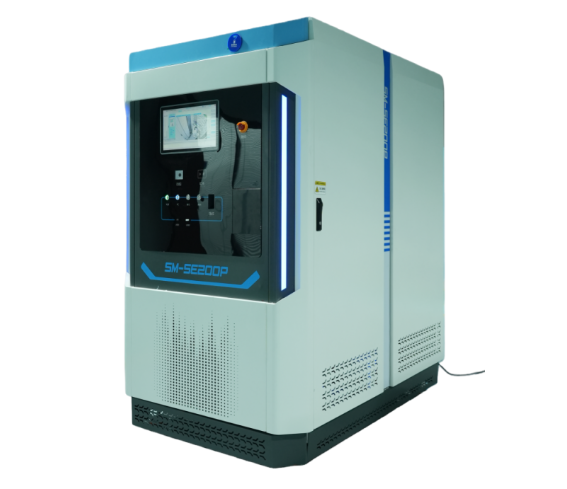
A domestic refrigerator can maintain low temperature, but it normally cannot manage individual container identity, expiration, temperature recovery, work-order binding, controlled dispensing or production traceability.
SunMoon Intelligence’s Solder Paste Storage Cabinet SM-SE200P integrates refrigerated storage, temperature recovery, configurable stirring, FIFO management, barcode identification, MES communication and traceability in one system.
Its main process capabilities include:
Refrigerated capacity for up to 200 bottles
Adjustable refrigeration range of 1–10°C
Stated temperature control accuracy of ±1°C
Real-time temperature values and curve display
Overtemperature alarms
Temperature-recovery capacity for up to 25 bottles
Adjustable recovery range of 18–28°C
Programmable recovery time from 0.1 to 99 hours
Manual, scheduled or MES-controlled material release
Automatic return to refrigeration when recovered material is not collected within the permitted period
Configurable stirring from 100 to 1,000 rpm for 1–10 minutes
Automatic barcode or QR-code identification
FIFO dispensing by loading time or production date
Expiration, overdue and safety-stock alerts
Forward and reverse material traceability
Operator verification through fingerprint, IC card or password
Production-data reporting and MES integration
The machine’s configurable range allows different material recipes to be created, but settings must still be matched to each solder paste’s technical requirements. For example, a recovery setpoint of 28°C should not be automatically used for a paste whose supplier specifies a maximum warming temperature of 25°C. Similarly, automatic stirring should be enabled only after its speed and duration have been validated. The SM-SE200P specifications and material-management functions are published by SunMoon Intelligence. (Sun Moon)
Before releasing solder paste to production, confirm that:
The material has been stored within its specified temperature range.
The container is within its use-by date.
The correct lot has been selected.
FIFO or FEFO rules have been followed.
The warming period was completed while the container remained sealed.
No forced heating was used.
The container has reached the validated production temperature.
Stirring parameters match the approved process.
Cumulative room-temperature exposure is being tracked.
Worked paste will not be mixed with fresh paste.
All receiving, storage, recovery and dispensing records are traceable.
Most conventional SMT solder pastes benefit from refrigerated storage, commonly within 0–10°C. Some specialty pastes require sub-zero storage, while others have different limits. Always follow the product TDS.
A common range is two to four hours for standard jars or cartridges, but large or frozen containers may require longer. The container must remain sealed during warming.
No. Forced heating can create uneven temperatures and accelerate chemical degradation. Use controlled room-temperature recovery within the paste supplier’s specified range.
No. Opening a cold container can cause atmospheric moisture to condense inside the paste, affecting printing and reflow performance.
An unopened container may sometimes be returned according to its TDS. Opened paste requires stricter control because repeated refrigeration can cause condensation. Record every cycle and keep used stencil paste separate from fresh material.
Warning signs include extreme flux separation, crusting, dryness, lumps, increased viscosity, poor stencil release and incomplete coalescence after reflow. Visual inspection alone is not sufficient; printing, viscosity or coalescence testing may be required.
FIFO is a good baseline, but FEFO is more reliable when different lots have different expiration dates. The system should consider production date, receiving date, use-by date and previous temperature-recovery history.
Reliable solder paste storage requires control of the complete material lifecycle—from receipt and refrigeration to warming, printing, return and final disposition.
The most important rules are to store paste within its product-specific temperature range, keep containers sealed during temperature recovery, avoid forced heating, track room-temperature exposure and prevent used material from contaminating fresh paste.
For factories handling multiple solder paste types, production lines or daily material releases, automated refrigeration, warming, FIFO dispensing and MES traceability can reduce manual errors and create a verifiable process history. SunMoon Intelligence provides intelligent solder paste storage and handling equipment designed to support these controlled SMT material-management workflows.
If you have any questions or need help, feel free to contact with our team.
Room 503, Building 7, NianDongUValleyScience Park, No. 63 Weixin Road, SuzhouCity, Jiangsu Province
Copyright © 2025 Suzhou SunMoon Intelligent Technology Co., Ltd All Rights Reserved. | Sitemap


 +86 13584829534
 +86 13584829534