 Whatsapp: +86 13584829534



Search for more information


A lab refrigerator and a solder paste refrigerator may show similar numbers on the temperature display, but they are designed for different jobs.
That difference matters in SMT production, where solder paste condition affects printing stability, viscosity and usable life.
Many laboratory refrigerators operate around 2–8°C, mainly for samples, reagents and other temperature-sensitive laboratory materials.
Solder paste storage requirements vary by formulation. Many conventional solder pastes are stored in a refrigerated range of roughly 0–10°C or 0–12°C, but the solder paste manufacturer's TDS should always be followed.
So the main question is not simply:
“Can the refrigerator reach 5°C?”
The better question is:
“Can it manage solder paste correctly before, during and after refrigeration?”
A laboratory refrigerator is built to maintain a controlled cold environment. For general sample storage, that is exactly what it needs to do.
Solder paste management involves more steps.
Before paste reaches the printing line, operators may need to control:
● Refrigerated storage
● Batch and expiry information
● FIFO usage
● Temperature recovery
● Stirring
● Material issue records
● Traceability
A normal lab fridge does not automatically manage these production steps.
Solder paste should not normally be opened and used immediately after being removed from refrigeration.
Cold paste needs time to return to the required working temperature. If operators take different jars out at different times or rely on handwritten records, the actual recovery time can become inconsistent.
This is where a dedicated solder paste refrigerator or storage system becomes more useful than a basic lab fridge.
It connects refrigeration with the next stage of solder paste preparation instead of treating storage as a separate process.
In a busy SMT factory, doors are opened repeatedly and different solder paste batches move in and out every day.
The real risk is often not whether the cabinet can cool to the required temperature. It is whether operators can clearly answer:
Which jar entered storage first?
Which batch should be used first?
Has this jar completed temperature recovery?
Has it been stirred?
How long has it been outside refrigeration?
A standard refrigerator usually leaves those questions to operators.
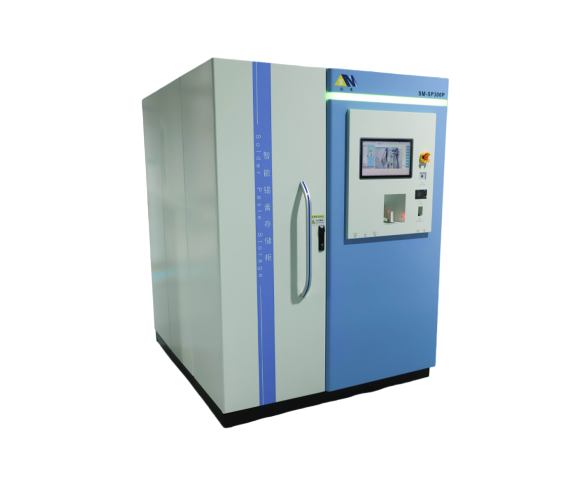
SunMoon's solder paste storage cabinet combines refrigeration with temperature recovery, stirring, FIFO, MES connection and traceability functions, rather than providing refrigeration alone.
For occasional solder paste storage and small-volume use, a suitable refrigerator may be enough when storage conditions are carefully controlled.
For factories managing dozens or hundreds of solder paste containers, the problem is different. Manual records, wrong FIFO order, incomplete recovery time and missed stirring steps can create more variation than the refrigerator temperature itself.
That is why a dedicated solder paste storage system makes more sense for high-volume SMT production: it manages the whole solder paste handling process, not just the cold temperature.
If you have any questions or need help, feel free to contact with our team.
Room 503, Building 7, NianDongUValleyScience Park, No. 63 Weixin Road, SuzhouCity, Jiangsu Province
Copyright © 2025 Suzhou SunMoon Intelligent Technology Co., Ltd All Rights Reserved. | Sitemap


 +86 13584829534
 +86 13584829534